 |
|||

|  |

|
|
Guest Columns
Perspective:
Dairy Markets
Ongoing saga of U.S.-Canada tariffs
Nate Donnay
Nate Donnay is director of dairy market insight at StoneX* Group Inc. and has been applying his interest in complex systems and statistical analysis to the international and U.S. dairy markets since 2005. He is a guest columnist for this week’s Cheese Market News®.
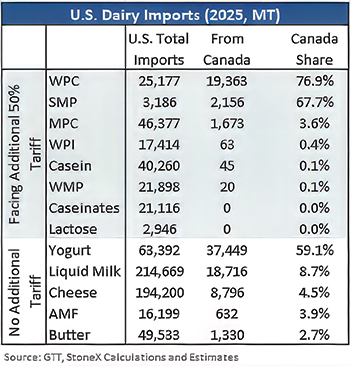 |
| Graphic provided by StoneX Group Inc. |
It’s safe to say that U.S. tariff law has more sections than a professional sports stadium. Toward the end of July, the Trump administration announced new Section 301 tariffs that effectively replace the Section 122 tariffs, which had temporarily replaced the IEEPA tariffs that were struck down by the Supreme Court. In addition to the new Section 301 tariffs, the administration also put new Section 338 tariffs on a variety of goods coming from Canada.
Fun fact: the Section 338 tariffs come from the Smoot-Hawley Tariff Act of 1930 which was made famous by.…anyone?....anyone?....Ben Stein in Ferris Bueller’s Day Off.
The Section 301 tariffs are probably the most straightforward and least impactful for the dairy markets. The administration is putting either flat 10% or 12.5% tariffs (depending on the country) on top of existing tariffs for 60 countries with the justification that these countries are not policing the use of forced labor well enough. There are five countries where the 10/12.5% rates aren’t added on top of existing tariffs, but if the existing tariffs are below the 10/12.5% rate, then those items will be charged a total of 10% or 12.5%.
The Section 338 tariffs are likely more meaningful for dairy. The U.S. government has determined that Canada is discriminating against the imports of U.S. dairy, alcohol and vehicles with their import policies, and announced in July an additional 50% tariff on the imports of a wide variety of products from Canada, including several dairy products. The tariffs went into effect on Aug. 22. Following the initiation of these tariffs, Canada announced retaliatory tariffs that went into place on Sept. 8.
The U.S. imports a decent amount of whey protein concentrate (WPC), yogurt, liquid milk and cheese from Canada, but out of that list, WPC is the only one being hit with the additional tariff. With the price of WPC80 near $12 per pound ($26,400 per metric ton), a 50% tariff is really going to hurt. At that price level, it wouldn’t be a surprise if we witness some buyers look to other opportunities, like Europe for example. In fact, we ought to expect it.
Ultimately, we won’t see data on the impact of tariffs for several weeks, and with how tight the WPC market is, it could take a couple of months to fully shift. In the short term, it is unlikely we will see any major change, and that’s to say nothing of the fact that no one really knows how long these tariffs could be in place for.
When the U.S. has placed tariffs on Canada in the past, Canada has tended to retaliate by putting additional tariffs on U.S. products (including dairy). Canada is a top five destination for most U.S. dairy products, so if they put additional tariffs on U.S. products, it could have a negative impact on U.S. dairy prices until U.S. exporters could find other homes for the dairy products.
While there remains real risk for the dairy industry, so far, the dairy markets have had no discernable reaction to the news of either tariff announcement. In our opinion, if the administration had made these announcements at the start of 2025, there likely would have been some significant movements in dairy futures prices. Given the news over the past year, it seems in many ways the market has become numb (or discounted) to the last few months of tariff news.
CMN
The views expressed by CMN’s guest columnists are their own opinions and do not necessarily reflect those of Cheese Market News®.
*This material should be construed as market commentary, merely observing economic, political and/or market conditions, and not intended to refer to any particular trading strategy, promotional element or quality of service provided by the FCM Division of StoneX Financial Inc. (“SFI”) or StoneX Markets LLC (“SXM”). SFI and SXM are not responsible for any redistribution of this material by third parties, or any trading decisions taken by persons not intended to view this material. Information contained herein was obtained from sources believed to be reliable, but is not guaranteed as to its accuracy.
| CMN article search |
   |
|
|
© 2026 Cheese Market News • Quarne Publishing, LLC • Legal Information • Online Privacy Policy • Terms and Conditions
Cheese Market News • Business/Advertising Office: P.O. Box 24 • Sun Prairie, WI 53590 • 608/831-6002
Cheese Market News • Editorial Office: 5315 Wall Street, Suite 100 • Madison, WI 53718 • 608/288-9090